· ReadyStack
Worked example
Real numbers from this tool, line by line.
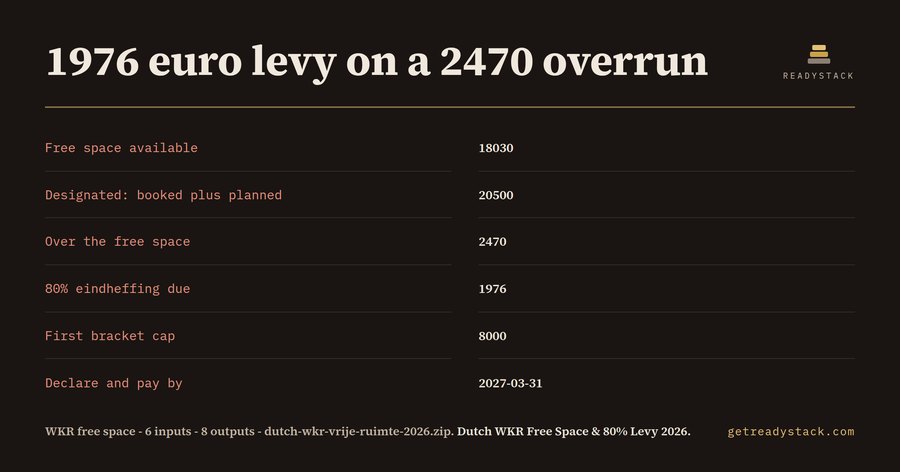
A Dutch payroll administrator with a 1250000 euro fiscal wage bill and 20500 euro designated to the free space owes 1976 euro of eindheffing, and after 2026-12-31 that number can no longer be changed.
That is the whole werkkostenregeling problem in one line. The free space is not a single percentage. For 2026 it is 2.00 percent of the first 400000 euro of the fiscal wage bill, capped at 8000 euro, plus 1.18 percent of everything above 400000. On a 1250000 euro wage bill that is 8000 plus 10030, so 18030 euro of room. Designate 14500 euro during the year and plan another 6000 euro of December spending - the staff party, the hampers, a gross bonus routed through the free space - and the total is 20500. The overrun is 2470 euro and the employer pays 80 percent of it: 1976 euro.
The trap is the year. From 1 January 2027 the first bracket rises from 2.00 to 2.16 percent, which moves the first-bracket cap from 8000 to 8640 euro. Run the same 1250000 euro wage bill at the 2027 rate and the free space is 18670 euro, the overrun is 1830 and the levy is 1464. That is 512 euro of difference on one wage bill, and it comes entirely from asking a tool that carries one blended percentage instead of two years. The extension keeps 2026 and 2027 as separate options, so the answer changes when the year changes.
The second thing a spreadsheet does not tell you is when the number stops being fixable. A cost only sits in the free space because you designated it there, and the last day to move one out is 2026-12-31. From 2026-09-22 that is 100 days. After that the only remaining question is where the levy is declared: monthly filers report the 2026 eindheffing in the second payroll return of 2027, due 2027-03-31, and four-weekly filers are due 2027-03-22. The extension prints the deadline that matches your own filing rhythm rather than the one that matches the article you read.
Six inputs, eight figures. You enter the fiscal wage bill from column 14, what is already designated, what is still planned, the plan year, your payroll return rhythm and today's date. You get the free space, the designated total, the amount over the line, the 80 percent eindheffing in euro, the headroom left, the first-bracket cap, the filing deadline and the days remaining. Nothing leaves the browser: the calculation runs in the popup and in the free web page from the same file.
All of that is free, with no key, no run limit and no watermark, in Chrome, Edge and Firefox from the same zip. The 60 dollar licence key changes the axis rather than the answer: it exports the run as a CSV ledger you can drop into the payroll file, and it sets alarms on the 2026-12-31 designation cut-off and on your filing deadline. For comparison, a self-employed Dutch tax advisor averages 145 euro an hour in 2026, with most charging between 80 and 180 euro an hour, and a year-end WKR review is two to three of those hours.
If you designate anything to the free space this quarter, the useful moment to run the numbers is now, while moving a 6000 euro December plan still costs nothing but a decision.
Questions people ask
What does this extension actually do?
It prices your werkkostenregeling position for 2026 from six inputs. It returns eight figures: the free space from both brackets, the designated total, the amount over the line, the 80 percent eindheffing in euro, the headroom left, the first-bracket cap, the filing deadline, and the days left before 2026-12-31.
Who is it for?
Dutch payroll administrators, in-house bookkeepers and HR leads at companies that run their own loonaangifte and designate perks such as the staff party, Christmas hampers, home-office allowances or gross bonuses to the free space. It is built for the people who must sign off the December payroll run, not for tax specialists.
Why not just ask a chatbot or use a free calculator?
Because the first-bracket percentage changed. A general assistant will often quote 2.16 percent, which is the rate from 1 January 2027, and price a 2026 wage bill with it. On a 1250000 euro wage bill that inflates the free space by 640 euro and hides part of the overrun. This tool holds 2.00 percent for 2026 and 2.16 percent for 2027 as separate years.
What is free and what needs the paid key?
Every calculation is free, with no key, no watermark and no run limit: the free space, the excess, the 80 percent levy, the first-bracket cap and the countdown. The 60 dollar key adds ownership and repetition: a CSV ledger of your runs for the payroll file, and alarms for the designation cut-off and the filing deadline.
What would this cost me otherwise?
A self-employed Dutch tax advisor averages 145 euro an hour in 2026, with most charging between 80 and 180 euro an hour. A year-end WKR review is two to three of those hours. The extension prices the same position in one screen and is free for the calculation itself.
Ask about this tool
One question, answered by the person who built it. Your email only if you want the answer sent.